How to Choose Soccer Training Wear Sizes for Adults and Youth Teams
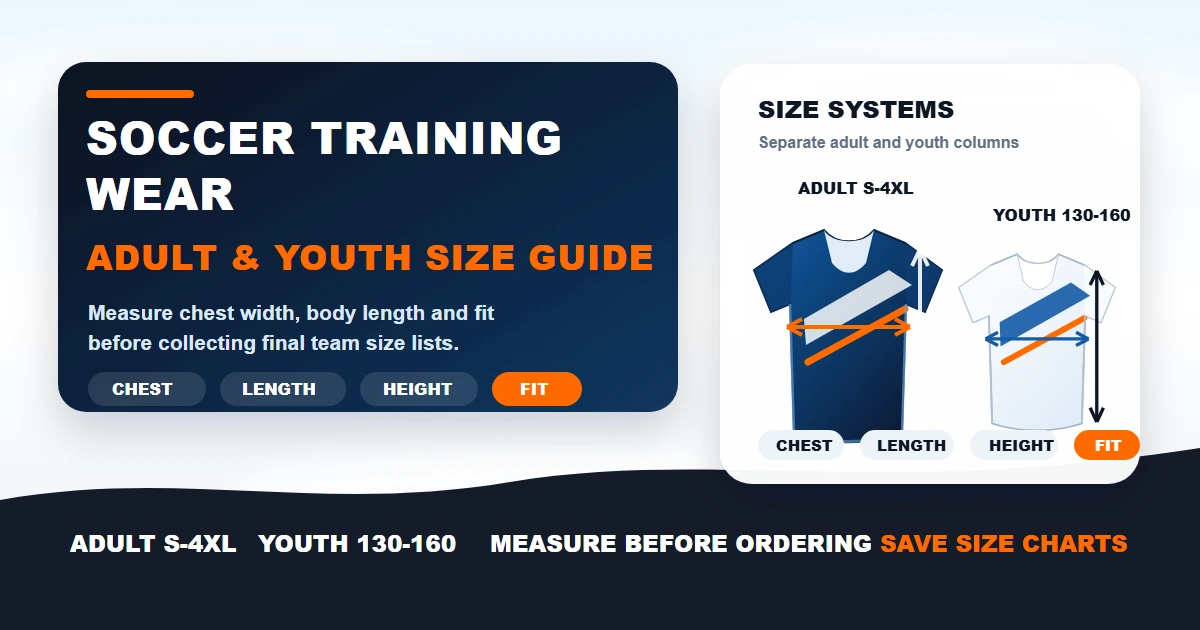
Choosing sizes for a soccer training wear order is not the same as buying one shirt for personal use. A team order has to fit many body types, cover both adult and youth players, support name and number printing, and still remain easy to repeat later. If the size list is unclear, the final problem is usually not the fabric or printing method. It is that some players receive shirts that are too tight, shorts that are too loose, or replacement pieces that no longer match the first batch.
This guide explains how academies, schools, youth clubs, adult amateur teams, distributors and tournament organizers can plan soccer training wear sizes before placing an order. It also explains how to separate adult and youth sizing, measure an existing garment, prepare a clean team list and avoid common repeat-order mistakes.
Why Team Orders Should Not Use Daily Clothing Sizes Only
Many buyers start by asking every player, “What size do you usually wear?” That is useful as a first reference, but it is not accurate enough for a teamwear order. Size names such as S, M and L can vary between brands, garment patterns, fabric types and target markets. A medium shirt from one supplier may be close to a large from another supplier. A stretch fabric may feel more forgiving than a non-stretch fabric, even if the measurement chart looks similar.
Soccer training wear also has different use cases. Some teams prefer a close athletic fit for warm-weather training. Others need a looser fit because players wear base layers underneath in autumn or winter. Goalkeepers and coaches may also need more room than field players. For this reason, a reliable soccer training wear size guide should be based on measured garment data, player body references and the actual wearing scenario.
If you are still choosing product types, review the main Soccer Training Wear page before finalizing the size list. Product structure affects fit, especially when ordering shirts, shorts and full sets together.
Separate Adult Sizes and Youth Sizes Before Counting
Adult sizes and youth sizes should be counted separately. Do not place adult S, M, L and youth 130, 140, 150, 160 in the same column. The size names belong to different systems and can cause confusion when the factory prepares production, packing and final checking.
For JGKIT soccer training wear planning, the common adult size range is S-4XL. The common youth size range is 130-160. These are planning references only. The final confirmation should always follow the actual measured size chart for the specific product.
| Size Group | Common Sizes | How to Use | Important Note |
|---|---|---|---|
| Adult | S, M, L, XL, 2XL, 3XL, 4XL | Adult teams, coaches, older students and larger youth players | Confirm chest width and body length against the measured chart |
| Youth | 130, 140, 150, 160 | Youth clubs, schools, camps and junior academies | Do not rely on age only; height and body type can vary widely |
What to Check in a Measured Size Chart
A measured size chart is more useful than a simple size name list. Buyers should check several values before confirming the final order.
Chest Width
Chest width is usually measured across the garment, from one underarm point to the other, with the shirt laid flat. This is one of the most important values for comfort. If the chest is too narrow, the player may feel restricted during running, passing and stretching.
Body Length
Body length is measured from the shoulder area down to the bottom hem. For soccer training wear, length matters because players need movement without the shirt riding up too much. A shirt that is too short may look acceptable when standing still but feel uncomfortable during training.
Recommended Height and Weight
Recommended height and weight are useful references, especially for youth teams. However, they should not be the only decision factor. Two players with the same height may have different shoulder width, chest size and fit preference.
Fit Preference
Ask whether the team wants a regular fit, loose fit or closer athletic fit. A school team may prefer a regular fit for general training. A competitive academy may prefer a more athletic cut. Coaches may want extra room for comfort.
Stretch Level
Stretch fabric can feel more flexible during training, while standard polyester may feel more structured. The same chest measurement can feel different depending on fabric stretch, fabric weight and garment cut.
If the team is also comparing fabric and printing methods, the Custom Soccer Jerseys Fabric, Printing and MOQ Guide can help buyers understand how material choice affects comfort and production planning.
How to Measure an Existing Well-Fitting Jersey
One practical way to reduce sizing mistakes is to measure a jersey that already fits the player well. This is especially useful when players are unsure whether they should choose a medium or large.
- Lay the jersey flat on a clean table.
- Smooth the fabric without stretching it.
- Measure the chest width from underarm to underarm.
- Measure body length from the shoulder area to the bottom hem.
- Compare those measurements with the supplier’s measured size chart.
- Do not choose size based only on height, weight or age.
This method is simple, but it gives the buyer a much stronger reference than a verbal size estimate. For youth players, it can also help parents understand why two children of the same age may need different sizes.
Adult Team Size Planning Example
For a 30-player adult team, the order can include 30 player sets plus 2 spare sets, for 32 sets in total. A reasonable sample plan may look like this:
| Adult Size | Player Sets | Suggested Spare Sets | Total |
|---|---|---|---|
| S | 3 | 0 | 3 |
| M | 8 | 1 | 9 |
| L | 10 | 1 | 11 |
| XL | 6 | 0 | 6 |
| 2XL | 3 | 0 | 3 |
In this example, M and L receive one extra set each because they are the most common sizes. Spare sets can solve late registration, size exchange or damage during distribution. For a team of 30, keeping one or two common spare sizes is usually more practical than ordering the exact player count only.
Youth Team Size Planning Example
A youth team order needs a different method. Age alone is not enough. In a group of 12-year-old players, some may be close to 140 cm while others may already be near 160 cm. For a 40-player youth team, the order can include 40 player sets plus 3 spare sets, for 43 sets in total. A sample distribution may look like this:
| Youth Size | Approximate Use | Player Sets | Spare Sets | Total |
|---|---|---|---|---|
| 130 | Smaller youth players | 6 | 0 | 6 |
| 140 | Junior players | 11 | 1 | 12 |
| 150 | Growing youth players | 14 | 1 | 15 |
| 160 | Taller youth players | 9 | 1 | 10 |
The goal is not to force every player into a size based on age. The goal is to combine height, body type, fit preference and actual garment measurements. Youth clubs should also remember that players can grow quickly, so a slightly more flexible size plan may reduce problems later in the season.
Loose Fit or Athletic Fit: Which Is Better?
There is no single correct fit for every soccer training wear order. The best choice depends on climate, training intensity and who will wear the set.
- Daily training: A regular fit is usually safer because players need comfort over long sessions.
- Summer training: Lightweight fabric and slightly relaxed sizing can improve airflow.
- Autumn and winter layering: Consider one size larger if players wear base layers underneath.
- Match warm-up: A clean regular fit often looks more uniform during team presentation.
- Goalkeepers: Extra room may be needed for movement, gloves and protective layers.
- Coaches: Comfort is usually more important than a tight athletic cut.
When buying from stock, compare available products in the Soccer Training Wear product category. If the team needs custom colors or special artwork, compare stock and custom options before confirming the size list.
Should Tops and Shorts Use the Same Size?
Not always. Some players have a larger upper body and slimmer waist. Others need larger shorts but a smaller top. If the order form only allows one size for the full set, the final distribution may be difficult.
A better team order form should allow top size and shorts size to be entered separately. This is especially useful for adult amateur teams, mixed-age training groups and school teams with different body types. It also helps when coaches order tops only or add extra shorts later.
How to Organize Names, Numbers and Sizes
Most mistakes happen when the list is collected through chat messages, screenshots or incomplete spreadsheets. A clean order sheet should use one row per player and clear columns.
| Player Name | Jersey Number | Top Size | Shorts Size | Youth or Adult | Special Notes |
|---|---|---|---|---|---|
| Example Player | 10 | M | L | Adult | Loose fit preferred |
| Example Youth | 18 | 150 | 150 | Youth | Check body length |
Before sending the list to production, check spelling, duplicate numbers, missing sizes and whether adult and youth size systems are clearly separated.
Repeat Orders: The Problems Buyers Often Miss
A common situation is that a club places 40 sets first and then needs 8 more sets one or two months later. Buyers often assume the repeat order is simple. In reality, the risk is not only the quantity. The real problems may include:
- The original style is out of stock.
- The fabric has changed.
- The same color has a small batch difference.
- The measured size chart has been updated.
- The new player list contains wrong names, numbers or sizes.
To reduce these risks, save the product code, color reference, measured size chart, design files and first order records. If the first order uses custom artwork, keep the approved mockup and print file. If the order uses ready-stock garments, record the exact product number and size table. Buyers can also review Ready Stock vs Custom Soccer Training Wear before deciding which route is easier to repeat.
Order Quantity and Lead Time
Lead time depends on order type, quantity, customization method and packing requirements. JGKIT uses the following planning reference:
- Ready-stock logo, name or number printing for 1-1000 sets: usually 1-3 days.
- Digital print personalized custom samples and small orders: usually 3-7 days.
- Bulk production orders: usually around 10-30 days.
These time ranges refer to production planning. Final delivery also depends on destination country, shipping method, customs clearance and whether the buyer confirms artwork and size lists on time.
Packaging and Shipping by Size, Player or Team
Packaging should match how the team will distribute the order. For a small club, packing by player name may be easiest. For a school or tournament, packing by size or team can save time. For wholesale orders, carton marks and SKU labels may be more important.
- Individual polybags by player name
- Size-based packing
- Team-based cartons
- Number labels
- Carton marks for export handling
Clear packing instructions should be sent before production is finished, not after the goods are ready to ship.
Checklist Before Placing the Order
- Confirm whether the order uses adult sizes, youth sizes or both.
- Keep adult S-4XL and youth 130-160 in separate columns.
- Check the measured size chart for the exact product.
- Measure at least one well-fitting existing jersey.
- Confirm chest width and body length.
- Choose regular, loose or athletic fit before collecting final sizes.
- Separate top size and shorts size when needed.
- Check player names and jersey numbers carefully.
- Add one or two spare common sizes for team orders.
- Save product code, color, size chart and approved artwork for repeat orders.
- Confirm production lead time and shipping deadline.
- Send packing instructions before production is completed.
FAQ
What size should a 150 cm youth player wear?
A 150 cm youth player may often start by checking size 150, but the final choice should depend on chest width, body length, body type and fit preference. Do not choose by height alone.
Can adult and youth sizes be mixed in one order?
Yes, adult and youth sizes can be included in one order, but they should be listed in separate columns. This avoids confusion between adult S-4XL and youth 130-160.
Should soccer training wear fit tightly or loosely?
Daily training usually works best with a regular fit. A closer fit may suit competitive teams, while a looser fit is better for layering, coaches or players who prefer more room.
Can tops and shorts use different sizes?
Yes. Tops and shorts can use different sizes when the player’s upper body and waist measurements do not match the same size. The order sheet should support separate top and shorts columns.
How many spare sets should a team order?
For small and medium team orders, one or two spare sets in the most common sizes are usually practical. Larger youth or tournament orders may need more reserve pieces.
Can we reorder the same sizes later?
Yes, but repeat orders are easier when the buyer saves the product code, color reference, measured size chart, design file and first order record. Without those details, the second batch may not match perfectly.
Need Help Confirming Soccer Training Wear Sizes?
Send JGKIT your player list, size breakdown, product reference, logo file and required delivery date. The team can help review whether your adult and youth size counts are clear before production.
Request a Soccer Training Wear Quote
Share your quantity, top sizes, shorts sizes, player names, numbers and delivery destination for a clearer quotation.